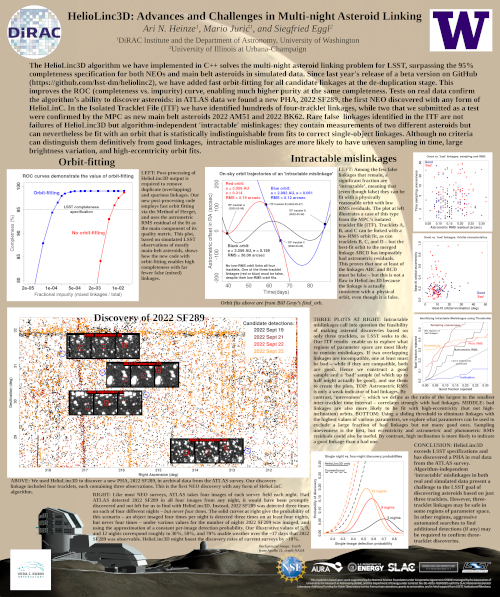
Abstract: The HelioLinc3D algorithm we have developed and implemented in C++ solves the multi-night asteroid linking problem for LSST, surpassing completeness specifications on both NEOs and main belt asteroids in simulated data. Since last year's release of a beta version on GitHub, we have added Method of Herget orbit-fitting for all candidate linkages at the post-processing and de-duplication stage. This reduces the already-low false positive rate by an additional large factor, and enables even higher completeness through careful choices of the acceptance thresholds. We report new tests of this capability on real data from ATLAS, Pan-STARRS, and the MPC's Isolated Tracklet File. Interestingly, the rare false positives that remain tend to be algorithm-independent 'intractable' mislinkages: that is, they contain measurements of two different asteroids but can nevertheless be fit with an orbit that is statistically indistinguishable from fits to correct single-object linkages. We discuss the regions of parameter space where intractable mislinkages occur, and prospects for validating true linkages in these problematic regions.